For students studying architecture at UT San Antonio, art is not confined to a museum or gallery. It is part of the environment where they learn, work and spend their days.
 That idea is at the heart of On the Walls: Art in Architectural Space, a new lunchtime series launched this past spring by the UT San Antonio Art Collection and the School of Architecture + Planning. The series brings artists into direct conversation with architecture students, creating opportunities to explore the artwork around them and consider how art and architecture shape the spaces people experience every day.
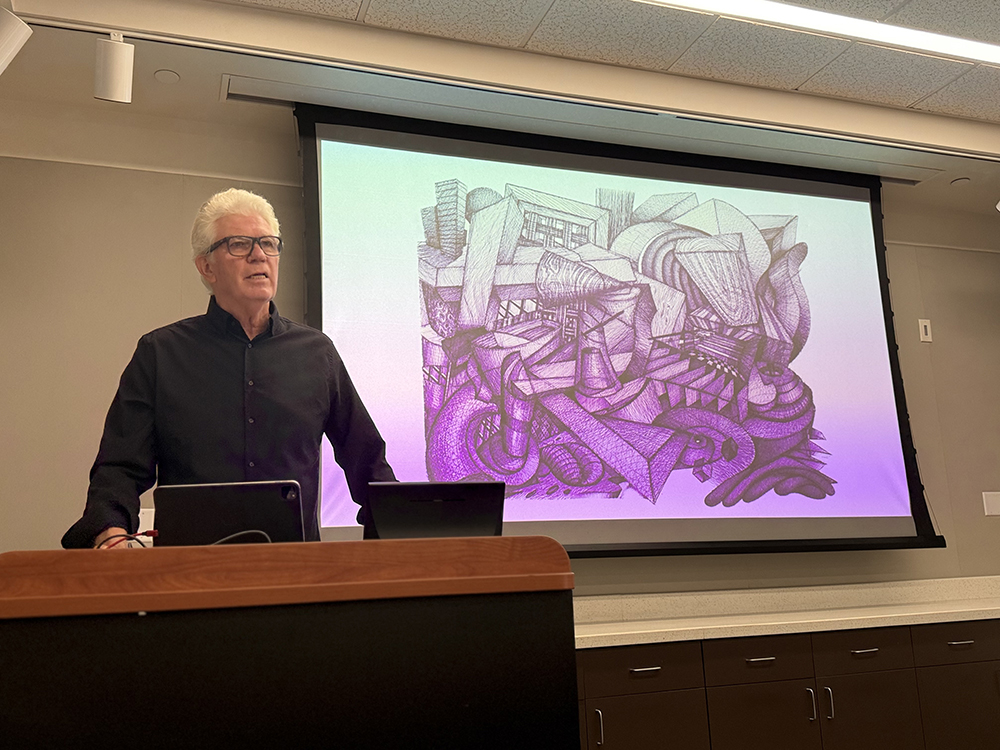
The inaugural session featured local artist and UT San Antonio graduate Mark Hogensen (MFA ’90), whose work is part of the university’s permanent collection. About 35 to 40 students and faculty attended the session at One Riverwalk Place, where Hogensen discussed his work and creative process and reflected on the relationship between art, architecture and the spaces where art is experienced.
For Hogensen, returning to the university as an artist was a full-circle moment. He earned his master’s degree in art only after starting out in architecture.
His background made him a fitting first artist for a series designed to bring the two disciplines into closer conversation.
Arturo Infante Almeida, director and curator of the UT San Antonio Art Collection, and Michelangelo Sabatino, director of the School of Architecture + Planning, created On the Walls with a shared goal: to connect students with artists and encourage them to look more closely at the art in their everyday environment.
“I created On the Walls: Art in Architectural Space to bring art and architecture together and strengthen the connection between the artists, their work, and the spaces we experience every day,” Almeida said. “Over time, I hope the series continues to grow, bringing more artists into the conversation and giving our students and community a deeper understanding of the art around them.”
The idea builds on the school’s move to One Riverwalk Place in the heart of downtown. For Sabatino, the new location offered more than a new home for the architecture program. It created an opportunity to use the building — and its place within downtown San Antonio — as a platform for students to engage with the city and the art within it.
The university’s art collection is an important part of that experience. Works in the building include paintings, photographs, tile and other media selected with the architectural environment and students in mind.
A series of photographs by renowned photographer Elliott Erwitt, for example, offers students a different way to think about observation and framing. Students routinely use their phones to photograph buildings, Sabatino said, but Erwitt’s work demonstrates that photography involves intentional choices about what to see, where to stand and how to frame a subject.
For Sabatino, those connections are fundamental to an architectural education.
“I think creativity need not be in silos,” he said. “There is art in architecture as well. And there is architecture in art.”
That philosophy has deep roots. Sabatino trained as an architect in Italy before earning a doctorate in art and architectural history, and he sees the historical relationship between the disciplines as something worth bringing into students’ contemporary education.
The school’s study-abroad program in Urbino, Italy, offers another example. There, students encounter art and architecture woven together throughout the city — in its streets, buildings, statues and frescoes. On the Walls brings that same idea into the students’ everyday environment in downtown San Antonio.
Hogensen’s work illustrates the possibilities.
His 58-foot tiled mural outside San Pedro I is part of the university’s permanent collection and is just a short walk from One Riverwalk Place. When discussing the mural with students, Hogensen described it as a “layering of ideas,” explaining how geometric structures, colors and shapes work together within the project’s parameters.
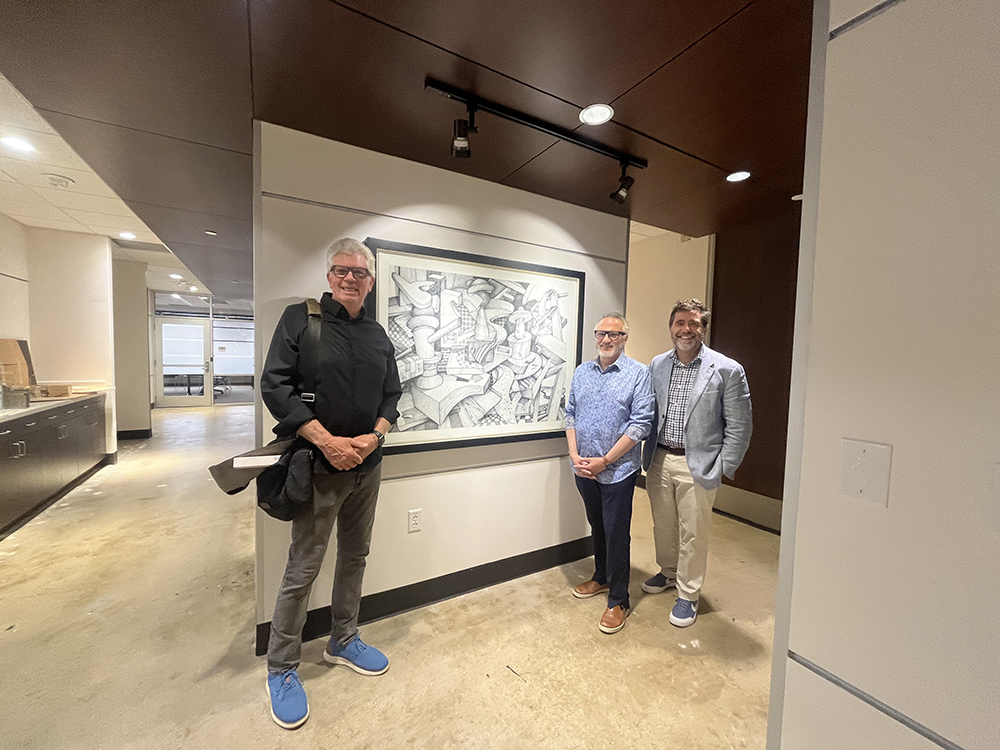
 Inside One Riverwalk Place, two of Hogensen’s works — an untitled ink perspective drawing and A Well-Oiled Machine — are displayed in the 10th-floor lobby. Placed across from one another, the works give students an opportunity to see different aspects of his practice, from line and perspective to color, geometry and composition.
The goal is not simply to place art in a building. It is to encourage students to stop, look and ask questions.
Sabatino has noticed students doing exactly that — pausing in the lobby to look at the artwork as they move through their day.
Hogensen also remembers what it was like to be a student listening to artists discuss their practices.
“I distinctly remember being on the other side, having people come and talk about their practice,” he said. “I was fascinated to hear from someone already out in the world.”
On the Walls will continue this fall with the arrival of artist Ernesto Ibanez on Wednesday, Oct. 14, from noon to 1 p.m. Ibanez’s artwork is on display on the fourth floor of One Riverwalk Place, giving students the chance to encounter his work in their everyday learning environment before hearing directly from him about his practice.
Ibanez will discuss his work and creative process and explore the relationship between sculpture and architectural space. His artwork has also been featured in the 2024 and 2025 UT San Antonio Gala & Art Sale.
For Almeida, that ongoing dialogue is what gives the series its purpose.
“On the Walls highlights the synergy between art and architecture, showing how they transform the spaces where we learn, work, and connect,” he said.
By bringing artists into the spaces where architecture students learn — and by connecting those works to the broader downtown environment — On the Walls offers students a chance to experience art not as something separate from architecture but as part of the same creative conversation.
Explore Further
- Explore the art and artists in the UT San Antonio Art Collection
- Learn more about The Arturo Infante Almeida UTSA Art Collection Endowment
- Learn more about the UT San Antonio School of Architecture + Planning